As we settle into the depths of winter, last summer’s warmth feels like a distant memory—and those sunny days of 2026 can’t come soon enough. These cold, snowy weeks offer a chance to reflect on what went well in 2025 and dream up ways to make the coming year even better, both personally and for… Read more »
blog
Blog
Downriver Canoe Company: 2026 Season Preview & What’s New This Year
Shenandoah River Adventures Await in 2026 Downriver Canoe Company is gearing up for another exciting season on the South Fork of the Shenandoah River. As we enter 2026, discover what’s new, what’s improved, and why your next river trip should start with us. 2026 Facility Upgrades for a Better Experience We’re investing in major facility… Read more »
A Season of Family: Reflecting on Our First Year at Downriver Canoe Company
As we prepare to close our doors for the season on October 31st, I find myself sitting on a chilly morning, watching the last few trips drift downstream. It’s been a quiet, contemplative week—one that gives us space to reflect on how much has changed in such a short time. The Beginning It was May… Read more »
End of an era, start of a new adventure
Fourteen years ago, I visited the Shenandoah Valley looking for a location to host an adventure race. With Shenandoah National Park, George Washington National Forest, and the Shenandoah River, the area was perfect as an outdoor adventure playground. Not long into the reconnaissance, I came across Downriver Canoe Company, an old-school outfitter nestled right on… Read more »
AN INDUSTRIAL LEGACY
During the nineteenth and most of the twentieth century a number of large, heavy industrial plants were located along the Shenandoah River. During most of that period the prevailing attitude was, “dilution is the solution to pollution”, so most of the liquid waste was simply dumped into the river with minimal processing. Won’t the river… Read more »
NUTRIENT LOADING
One of the most significant environmental threats to the Shenandoah River is nutrient loading; too much of the stuff that makes plants grow (mainly nitrogen and phosphorus) getting into the river and making the tiniest of plants (algae) grow out of control. When the algae matures, dies, and decomposes it consumes oxygen from the water… Read more »
DAMS, RIVER GAUGES, AND FLOW
There are a number of river gauges along the South Fork of the Shenandoah River which give the river level in feet for that location, but each gauge is independent of the others in its reading and rate of change, which makes it difficult to compare the readings of various gauges by using river level… Read more »
SIXTY-SEVEN
It was late October, just one weekend before closing our canoe business for the season. Closing a business down for the winter is a process. The vehicles have to be serviced and winterized and readied for the spring surge. All the canoes and kayaks have to be gone through, repaired, and put into storage. And… Read more »
ABOUT PADDLES
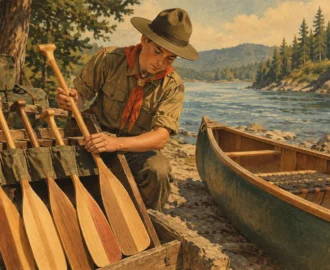
Canoe paddles are simplicity itself. You have three basic parts: the grip, the shaft, and the blade. Traditionally paddles were made of wood, often with blades laminated with different colors or types of wood for decoration. But today, paddles come in many different styles depending on intended use. THE GRIP There are two basic types… Read more »
FISH DYNAMICS
The Shenandoah River is legendary for its bass fishery. In the late 90’s catches of up to a hundred fish per person a day were not uncommon, but this is not always the case. In fact, bass are not even native to the Shenandoah River. You wouldn’t be wrong in calling them an invasive species…. Read more »
HOW TO READ A RIVER
We try to inquire “How was your float today?” as folks come off the river. When the river is low, some will say “It was just lovely” and some will say “It was fun, but we kept getting stuck.” The difference will often be in how well you can read the river, where the deep… Read more »
KAYAKS
Kayaks come in many forms each designed to fit a certain niche so to speak. Kayaks were historically used by indigenous peoples of the northern latitudes for hunting and fishing in their icy costal waters. A traditional Eskimo kayak would be made from seal skins sewn together stretched over a driftwood frame and paddled solo… Read more »